Deep Dive

Also available on Epic Games Store, PlayStation 5 and Xbox Series X|S
I’ve had the incredible honour to work on Fading Echo as an Intern Designer close to the end of its production, and this article will talk about my experience there!
I obviously will not talk about EVERY aspect of the game, as I was only present for a fraction of the production time, so more focus on Design will be present than other articles.
Fading Echo is an Action-Adventure game centered around systemic Fluid interactions, fast-paced combat, and exploration. You play as One, a Legend capable of morphing into different Fluids, fighting to save her home Corel.
The bulk of the work I did on the game focused on the Fluid System and mainly the combat, so let’s start diving into those!
Also, here is your Spoiler Warning.
I won’t talk about the story or anything, but documents and/or example might spoil zones, characters or enemies without warnings!!
Be Water Plasma my Friend
Fading Echo’s central core feature is its Fluid System: Three base Fluids being Water, Lava and Waste compose the core of the system, and their interactions are entirely Systemic.
Systemic in this case means that some rules are designed, and those rules apply without exception, making an open-ended gameplay where situations emerge naturally.
What this means is that some specific interaction “Water on Lava” was designed to create Cooled Lava. This is a stable and harmless ground that is ALWAYS the result of “Water on Lava”, no matter the source.
If an enemy shoots Water on some Lava, if One flops into Lava while being in Waterform, if a Water Core explodes onto lava, the result is always Cooled Lava being created.
As a Player, you can try to place Water on Lava no matter the source of Water and the result is always predictable.
Placing Water onto Lava, no matter the source, always produces the same result
One of my tasks as Designer on the project was to rework one of those Systemic creations: Burning Waste, the result of mixing Waste and Lava together.
This Fluid propagated into Waste, burned entities just like Lava, and stayed on the ground for a while, meaning that any complex combat Arena ended up being covered in Burning Waste for minutes at a time, rendering fighting on this terrain complex.
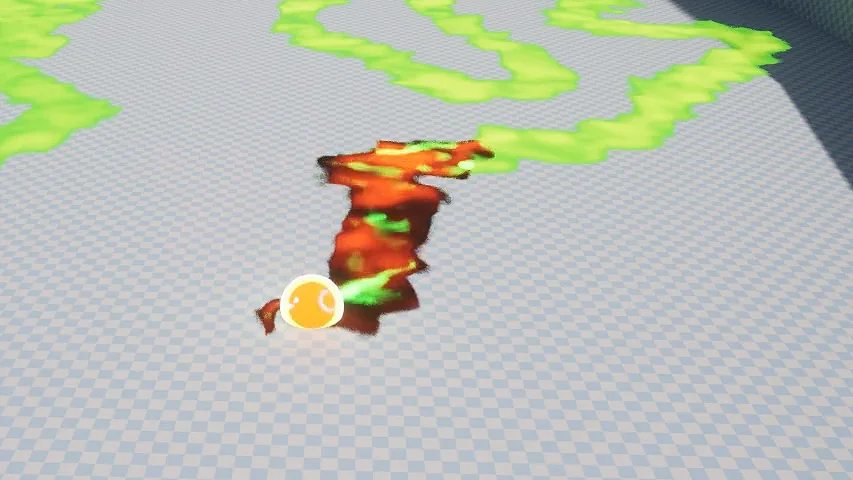
This is what the Burning Waste looked like previously
My proposition was to turn Burning Waste into its own Fluid: “Plasma“.
This fluid has several properties that improve its experience, the first of them being its “cleaning agent” aspect.
Plasma is created by mixing Waste and Lava, and propagates very quickly into both of them*. It then disappears in five seconds top to leave the untouched, clean ground below it.
*It initially only propagated into Waste, but we iterated on it and it turned out more interesting that way.
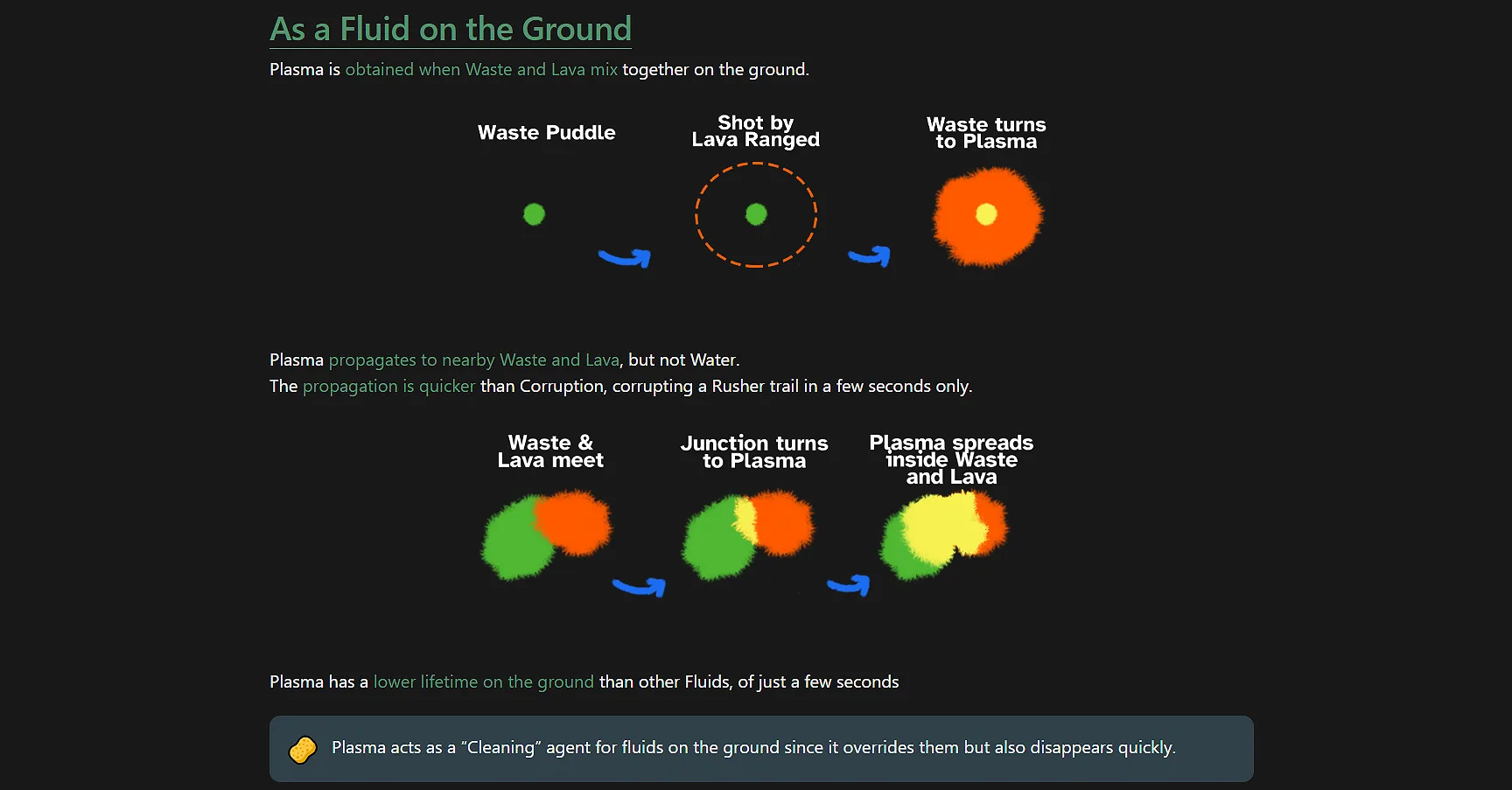
Initially Plasma was supposed to only spread inside of Waste but not Lava, however to avoid confusing the different iterations, I edited the document to show the final result. I kept the original name “Plasma” though.
Due to this Fluid only appearing when crossing two Fluids at once (an Artificial Fluid of sorts), the player can voluntarily trigger its creation using the Systemic rules, and clean an entire arena’s worth of ground. Its accidental appearance due to the enemies’ behaviour also will just have a cleaning effect on the arena, instead of polluting it with burning fluid that never goes away.
This also helped reduce the visual noise and cognitive load of later combats since the arenas now have built-in “clean switches” that can be triggered to simplify the terrain easily.
See how quickly it cleans the ground!
Burning Waste also had a playable form that got triggered by entering Lava (or Burning Waste) while being in Waste form.
This form got changed into the Plasmaform, which can be triggered by any contact with Plasma (as well as Waste into Lava since Nitro is a combination of the two). The need to go from one Fluid to another felt arbitrary and confusing to Players, so we simplified it: the Plasma Fluid gives you the Plasma Form, like every other fluid in the game.
Since the game is systemic, those rules had to be entered into the System: Plasma needed to increase a “Plasma Gauge” that affected Status Effects, Elemental Resistances, Form changes, and many other aspects.
Previously the Burning Waste only used the Lava reactions, so an entire set of systemic reactions and Status Effects had to be designed for this new Fluid.
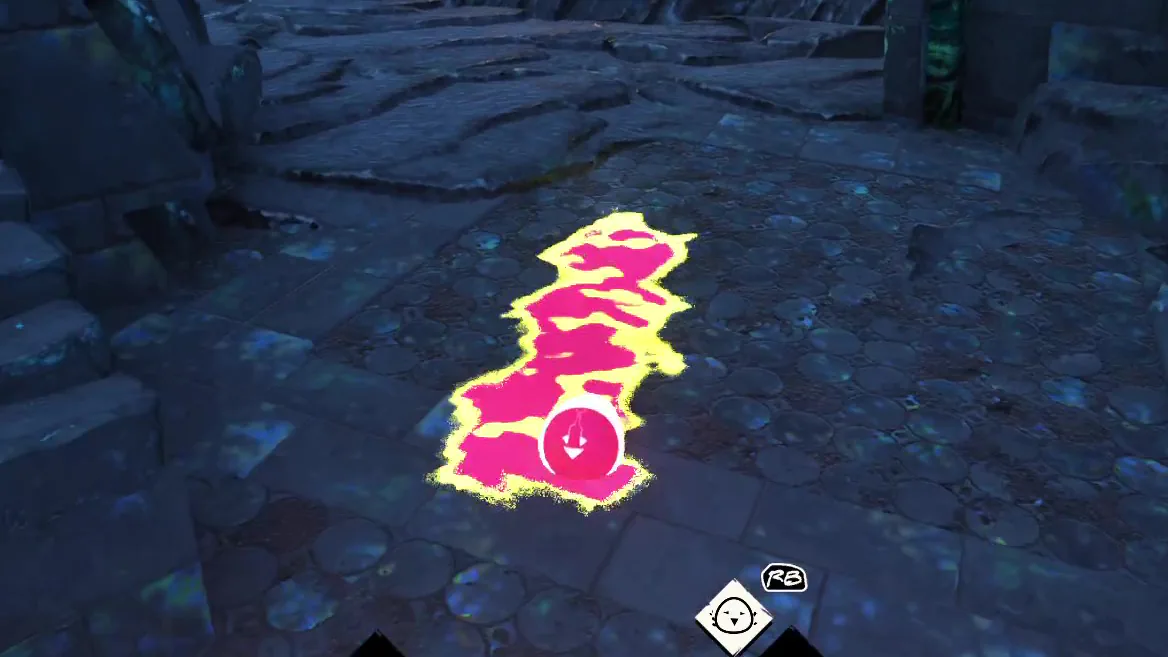
Plasma’s new visual, I like it!
Status Effects… Let’s talk about the Plasma Status Effect!
My first proposal for the Status Effect linked to the Plasma Fluid was called “Ionized“.
I simply took a cut Status Effect from the vault, called “Unstabled”, and expanded on it:
Ionized Entities periodically explode, damaging themselves and placing Plasma around them to create chain reactions.
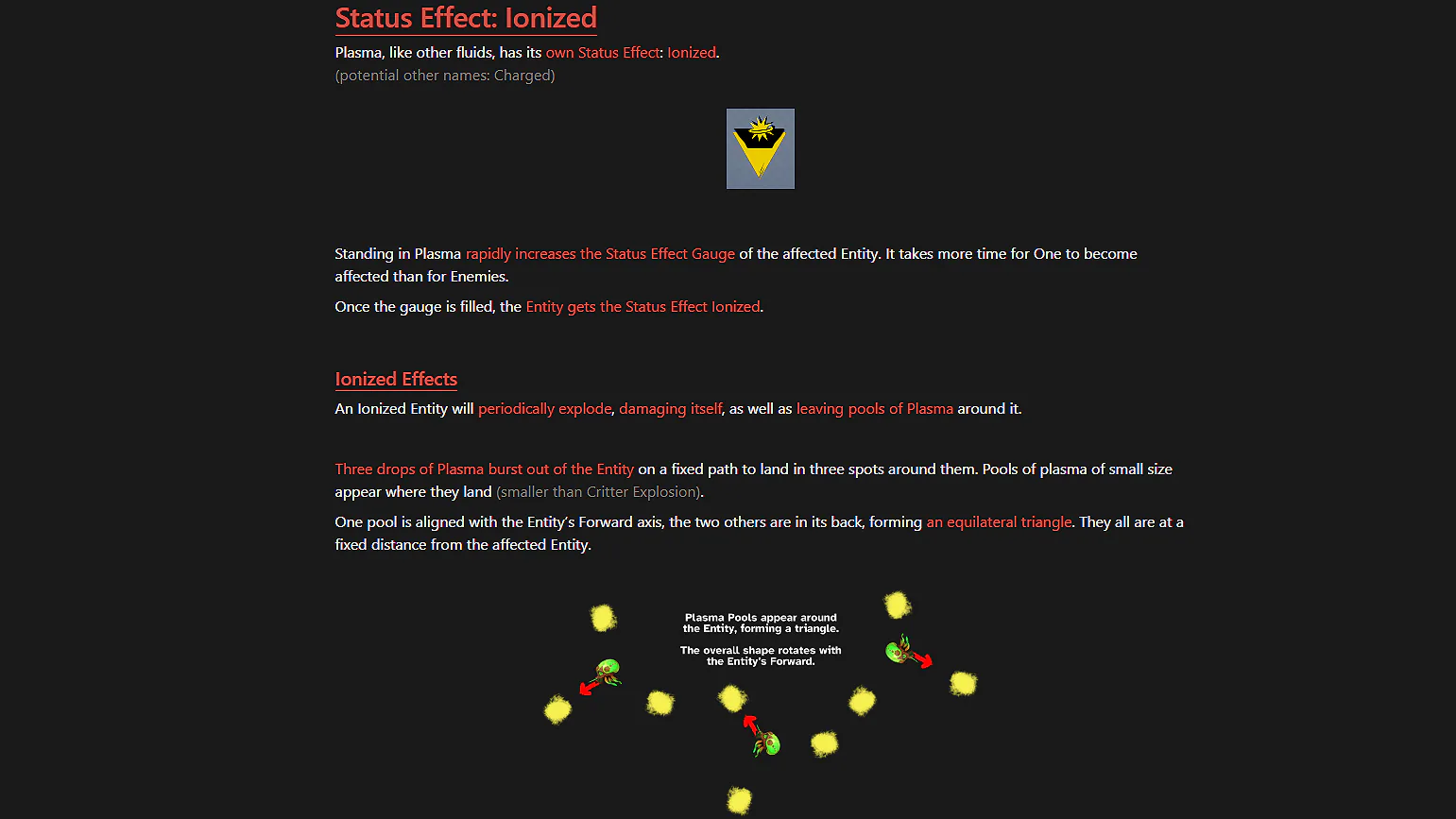
The initial design document for Ionized, with its original yellow colours
The “Placing Plasma” part was very troublesome however, for two main reasons:
The first is that enemies would place Plasma around them, but they would end up walking into the Plasma they placed, refreshing the Ionized timer. This meant that, in practice, they would stay Ionized almost forever once affected, and ended up dying by themselves without any Player Interaction due to the constant explosions.
The second is that feedbacking this to player was complex in such a fast-paced game environment. A lot of work was put into thinking about solutions to visually make them appear from Plasma Drops that exploded out of the Entity, but testing proved that this was completely missed no matter how much we exaggerated the feedbacks.
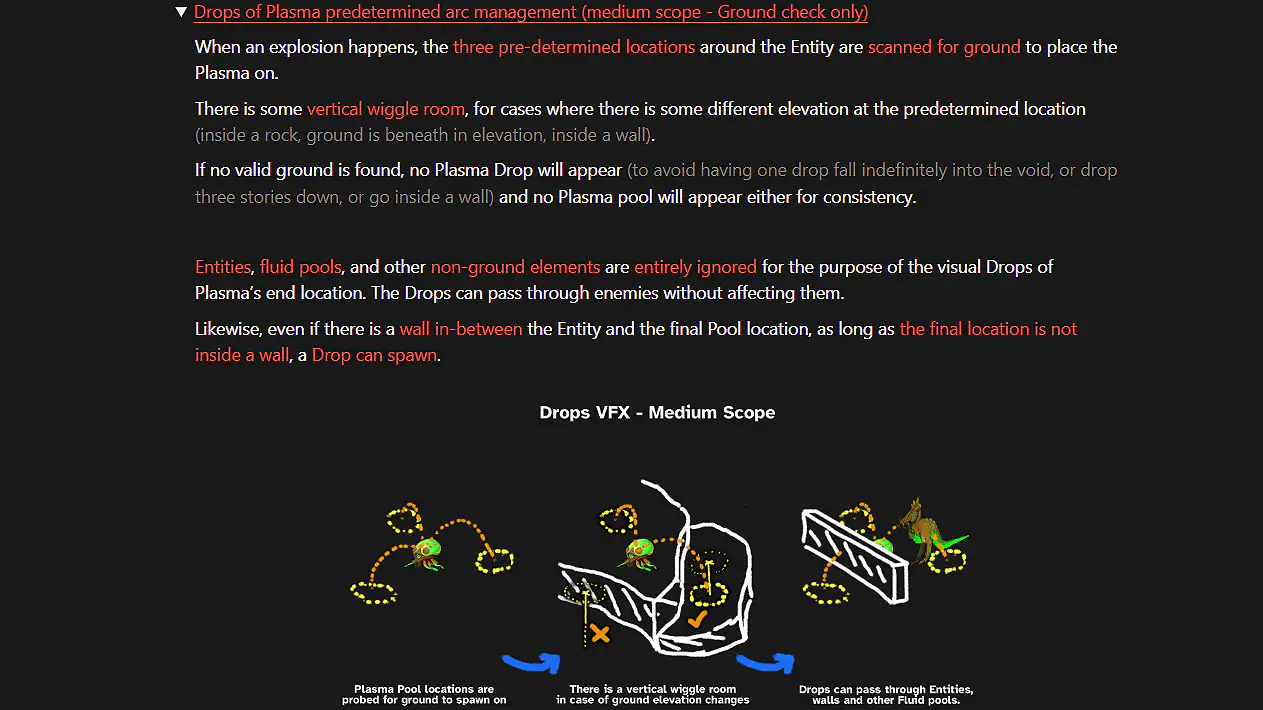
This is only the “medium Scope” for the Plasma drops. I usually make “low scope” proposals for if we do not have much production time to give to a feature, “high scope” for if we have a lot of time, and a “medium scope” that’s in-between.
We ended up scrapping the Ionized concept altogether in favour of another Status Effect: “Dazed”. By that time Plasma got renamed into “Nitro” and its colour got changed from yellow to a saturated magenta, however I’ll keep using “Plasma” for clarity’s sake!
I got the request of finding another effect that invoked more the feeling of old cartoons while keeping the fun “fuse and explosion” feel that Plasma got associated with, think Looney Toons turning into piles of ashes after a bomb detonates, something of that nature.
The proposal that got adopted was a low-damage explosion that send Entities leaping upwards toon-style, and stunning them when then land back on the ground. The goal was to get a fun reaction out of players, to reward smart usage of a Fluid that is so volatile and complex to create in the first place.
A lot of balancing was needed to not make this effect overpowered, as you now had access to a Plasmaform that placed on the ground a fluid that damaged and stunned enemies in a second; but in the end with combinations of lower movement speed, low damage, post-Status Effect fluid immunity and buffing other Status Effects, we managed just that.
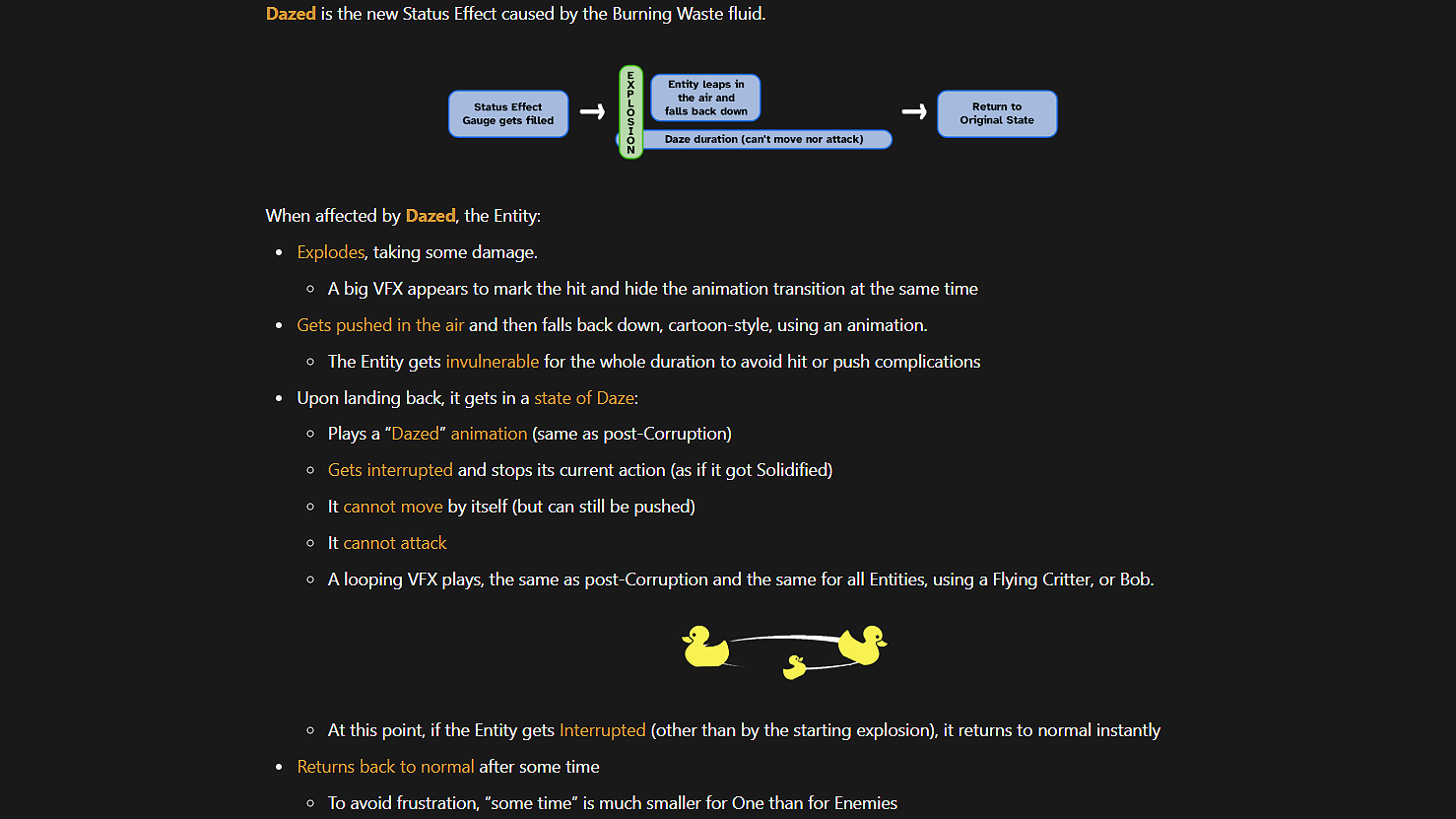
The newer version, Dazed, also has its own shiny document
Core of the Combat
The main aspect of my work on Fading Echo was directly linked to the Combat, be it enemies, attacks or the Arenas themselves.
Over the course of a month, Level Designer Corentin MANGÉ and I made a pass over every combat Arena in the game and reworked them with new guidelines.
The goal was to give all of them a clear identity: focus on a concept, on an enemy, on one piece of the environment and theme the entire combat Arena around it. This was accompanied by sets of guidelines we wrote to streamline the experience by preventing certain enemy types in certain zones to limit confusion, or rules on how to introduce specific aspects of the fight.
Several Arenas were also turned into gimmicks to make them even more contrasted: the same enemy type appearing over and over, the entire floor being a fluid pond, etc. They were sparsely used, but they still helped making certain zones more memorable.
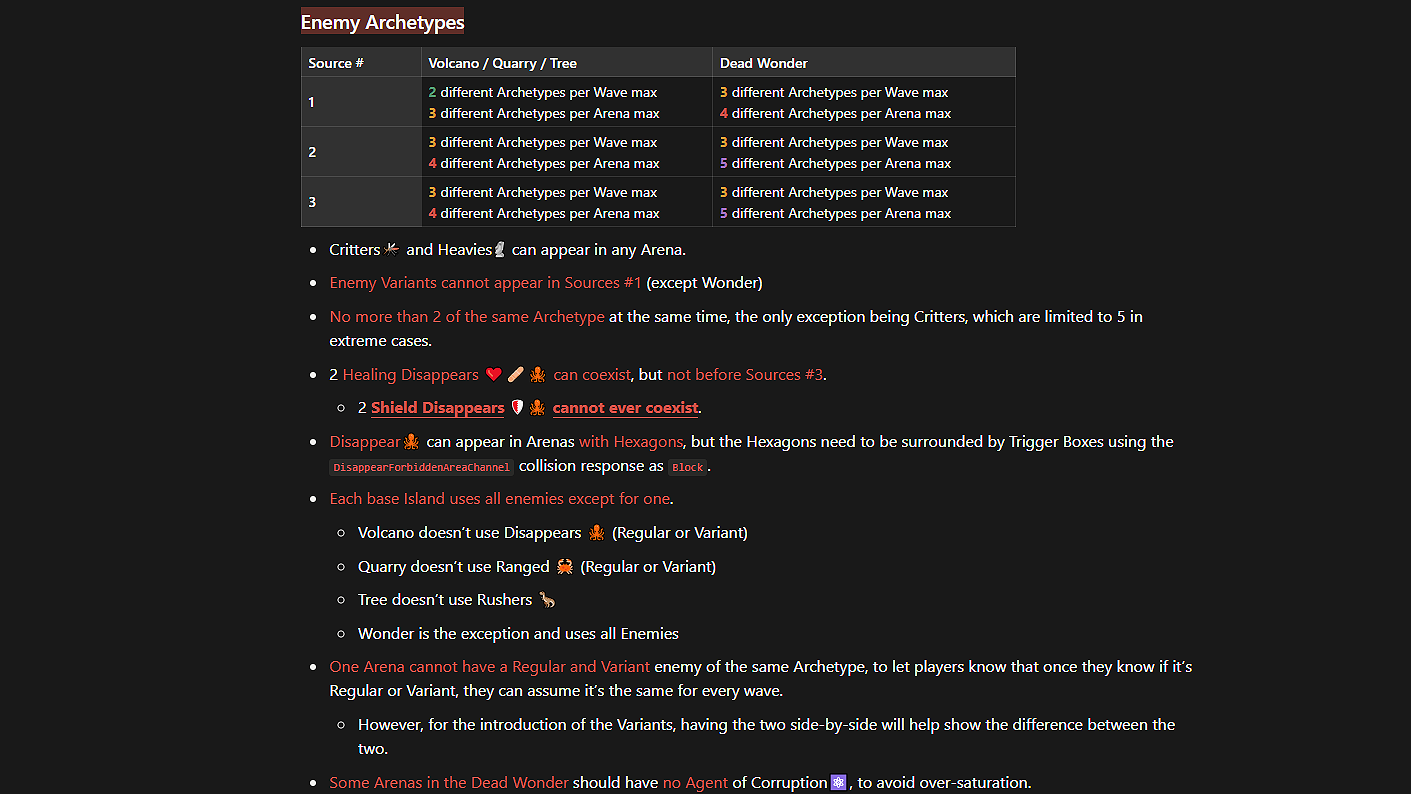
This document is magnitudes bigger than this screenshot, but this one image is enough to get its purpose.
Another big pass over the whole game was the big Attack Signal Harmonization pass.
What does that even mean?
Enemies give to the player a signal, a sign that they are preparing an attack. During the prototyping phase of the game several were put in place, but as time went on and as the enemies got more diverse, the signals ended up being desynchronized between enemies types.
Some attacks had a visual “danger zone” on the ground, others didn’t. Some had the body of the enemy flash red just before the attack, others had it at the very start of the animation, and others didn’t have it at all.
My goal was to make simple, clear rules to harmonize all of those attack signals, and then apply them over the entire game.
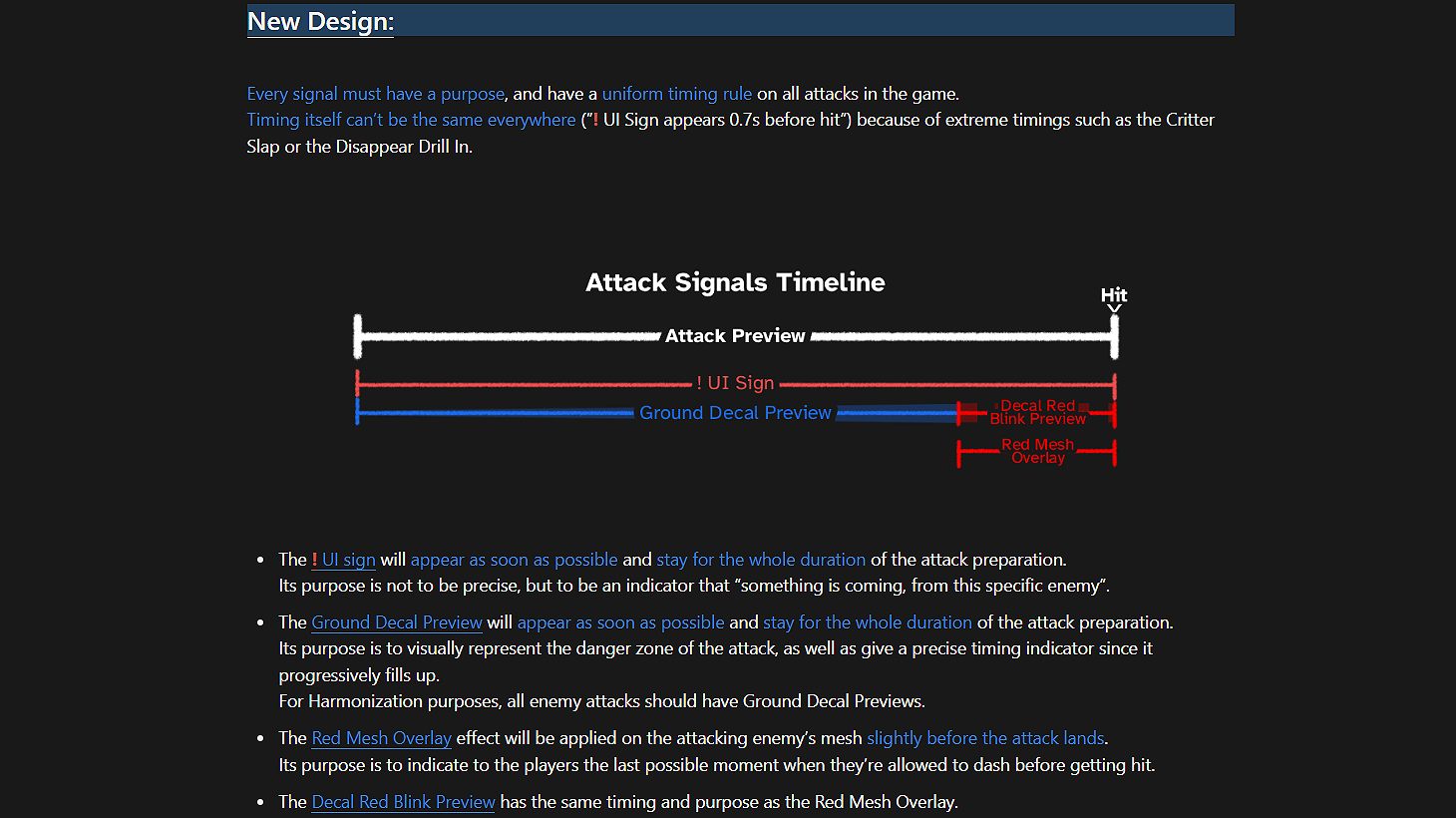
Four different signs combine to make every attack as clear as possible, even if only subconsciously.
Speaking of Enemy Attacks
One big change I’ve participated on is the rework of an enemy internally called the Disappear (officially called the Tendrill): a squid-like creature that drills in and out of the ground to move, leaving fluid ponds in its wake.
The original concept for this enemy felt like it was missing something: it just drilled in and out and tried to damage you on its way up, but it was easy to ignore and it didn’t feel like its addition in an arena actually changed anything.
The solution we came up with was to transform the Disappear into a support Healer role.
It now drilled in and out like before, but it avoided spawning too close to One. It instead preferred being farther away, as when out of the ground it can build up and release a healing pulse that restores health for all enemies in the arena.
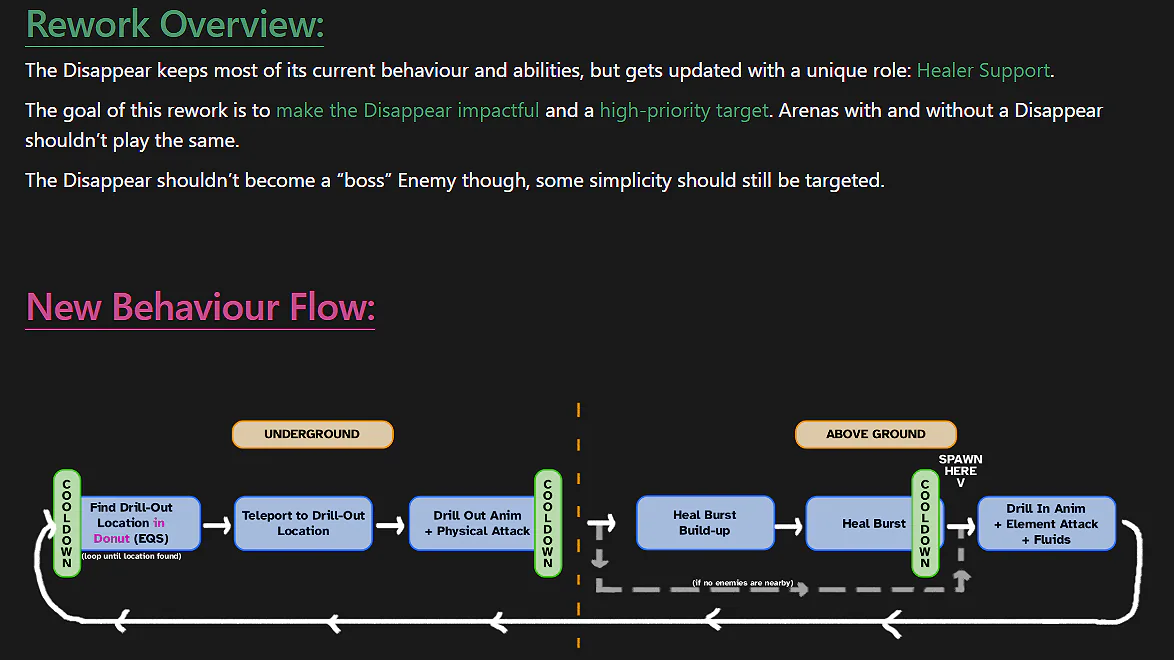
This behaviour flow describes how the new Disappear should work, and how it differs from its previous behaviour
Several rounds of iteration were obviously done over the following months to fine-tune its underground pathfinding, the spawn distances, the damages it deals, when its underground invulnerabilities start and end, etc.
This resulted in an enemy that now is meaningful when present in a combat arena, that is a priority target for players, and personally my favourite enemy of the bunch!
The Shiny Secondary Suite
Around January 2026, we were at a transititionary period in the production where a lot of placeholders and work-in-progresses were being replaced by final assets, and one issue came up: the “HUD Overlay”, the patterns and colours on the edges of the screen, were still placeholders and were not noticed by players.
This Overlay’s purpose is to indicate to players when they get damaged, when they are low on Health, and what Status Effect currently is affecting them. It is not the only sign showing them, but it still is important to have.
This is how it originally looked, video taken in one of our maps used for testing
A rework was needed, not just visually, but also mechanically: We needed to unify the feedbacks, give them a coherent language, and make them more visible.
It could be divided in “Status Effect Overlays” and the other two.
For the other two, the Low Health overlay was the simplest of them: a pulsating pattern on the edges of the screen that indicates you’re in danger.
The Damage Overlay received a few tweaks mainly in how it appeared, with the core of the change being trying to visually indicate to players the difference between Damage over time (Burning Status Effect) and separate damage sources being close-by.
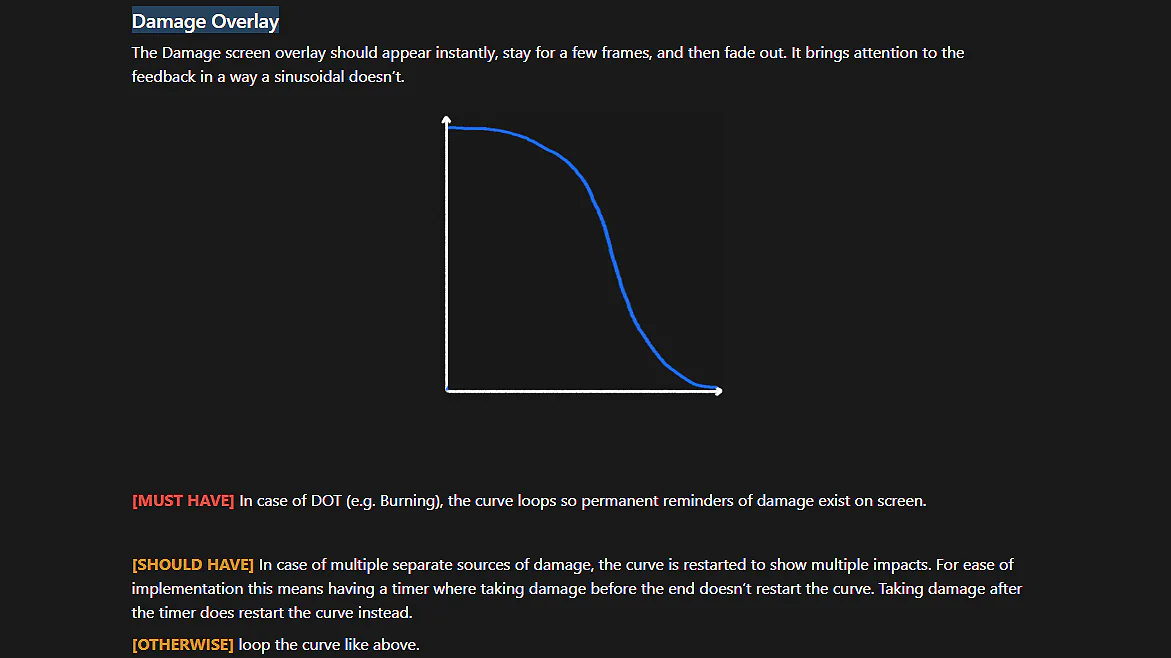
The curve is the key to make it feel punchy and visible while not overwhelming. Do not ever keep a regular linear curve ever ever!
Internal playtesting with team members—telling them they’d be testing another feature completely to not bias their experience, proved instantly a change. Most of them actively reacted (visually or audibly) to every hit they took, whereas previously hits could be easily missed when playing.
This was the proof of success we waited for before going further with that rework.
The big change, every Status Effect Overlay, functions in the same simple way: a pattern with a colour that appears on the side of the screen for as long as the Effect lasts. The actual end result differs greatly between my initial proposal and the final in-game product, so I’ll show a bit of both:
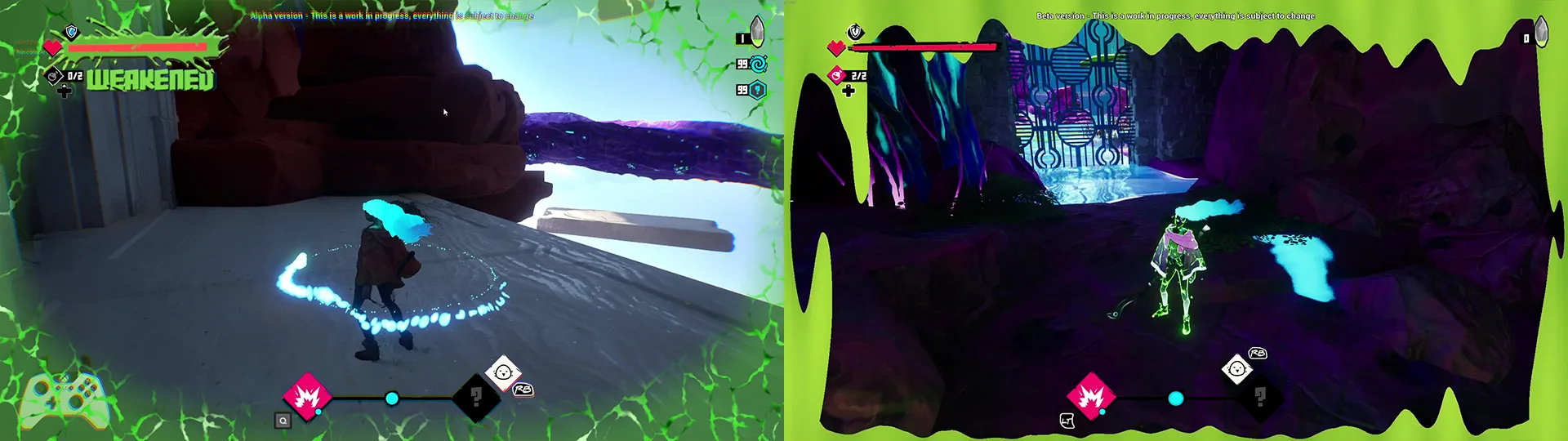
Weakened Status Effect – Mock-up (left) and final result (right)
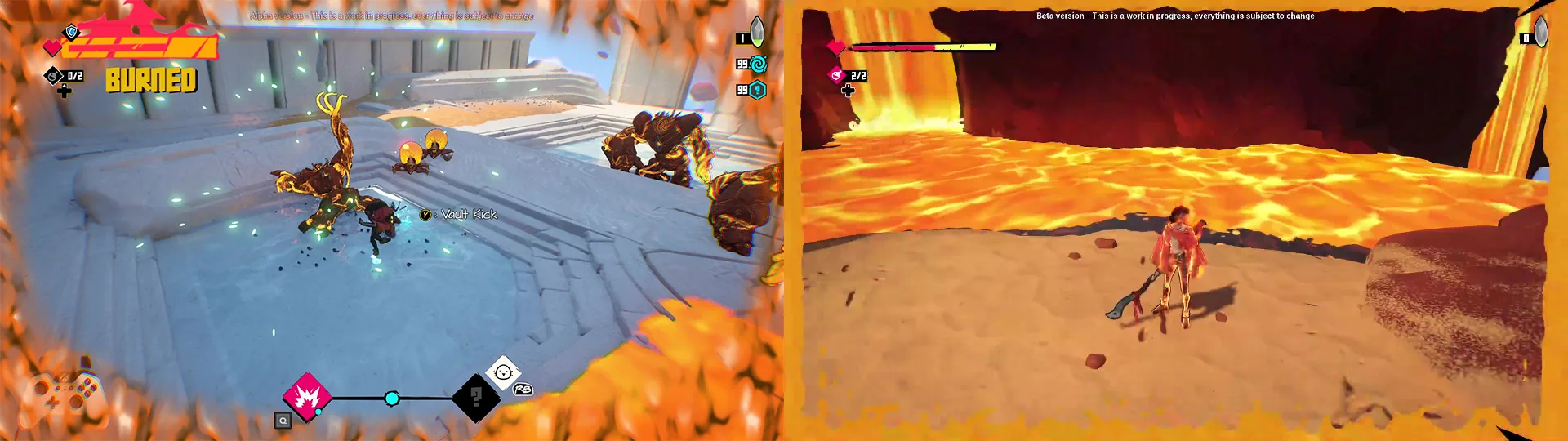
Burning Status Effect – Mock-up (left) and final result (right)
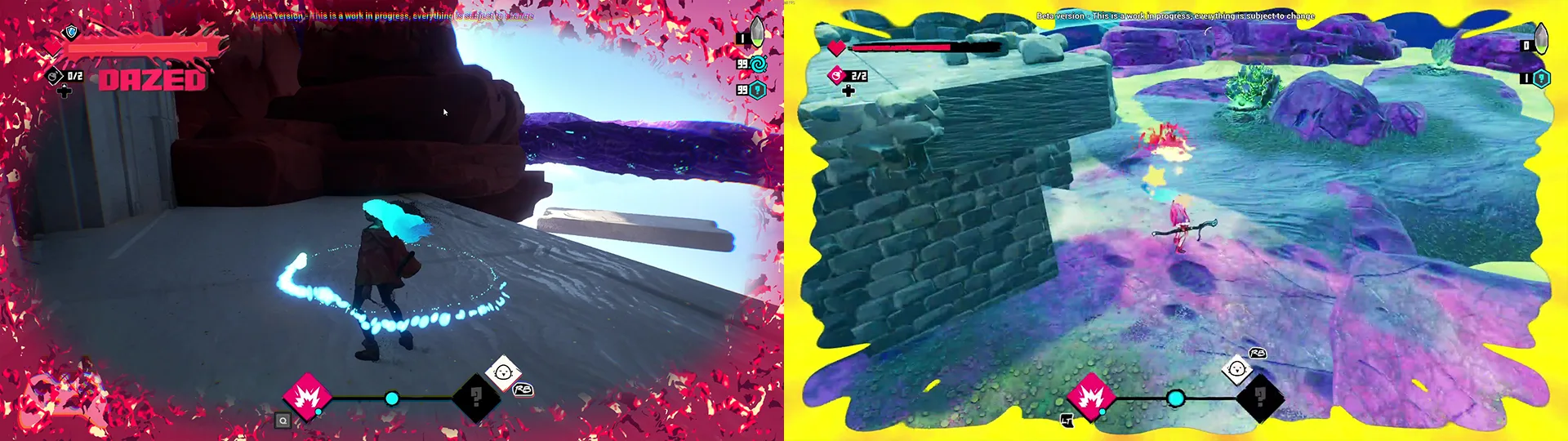
Dazed Status Effect – Mock-up (left) and final result (right)
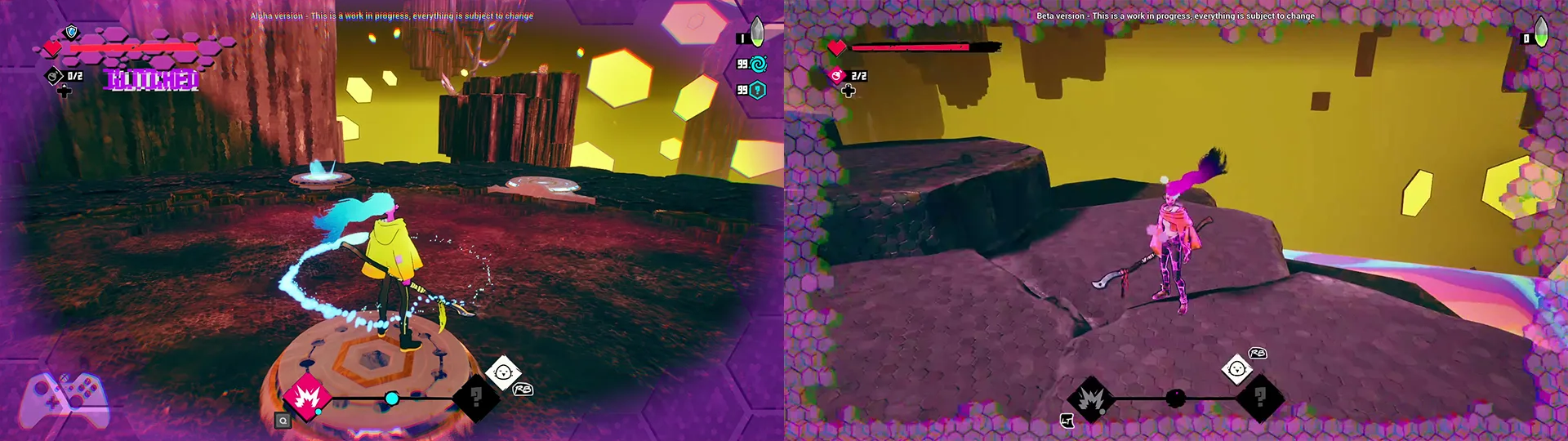
Glitched Status Effect – Mock-up (left) and final result (right)
I also had the privilege to design a majority of the Achievements for the game!
The design process was separated in a few steps: a disorganized brainstorm to gather as many ideas as possible, then a refining process to only keep the most interesting concepts, and a final selection to balance out feasibility and game rhythm with production time.
The first selection had over 60 rough ideas that we ended up refining into 30 concrete Achievements, trying to keep a healthy balance of goals based on Game Progression, fun Objectives, Story relevance and secondary Collectibles.
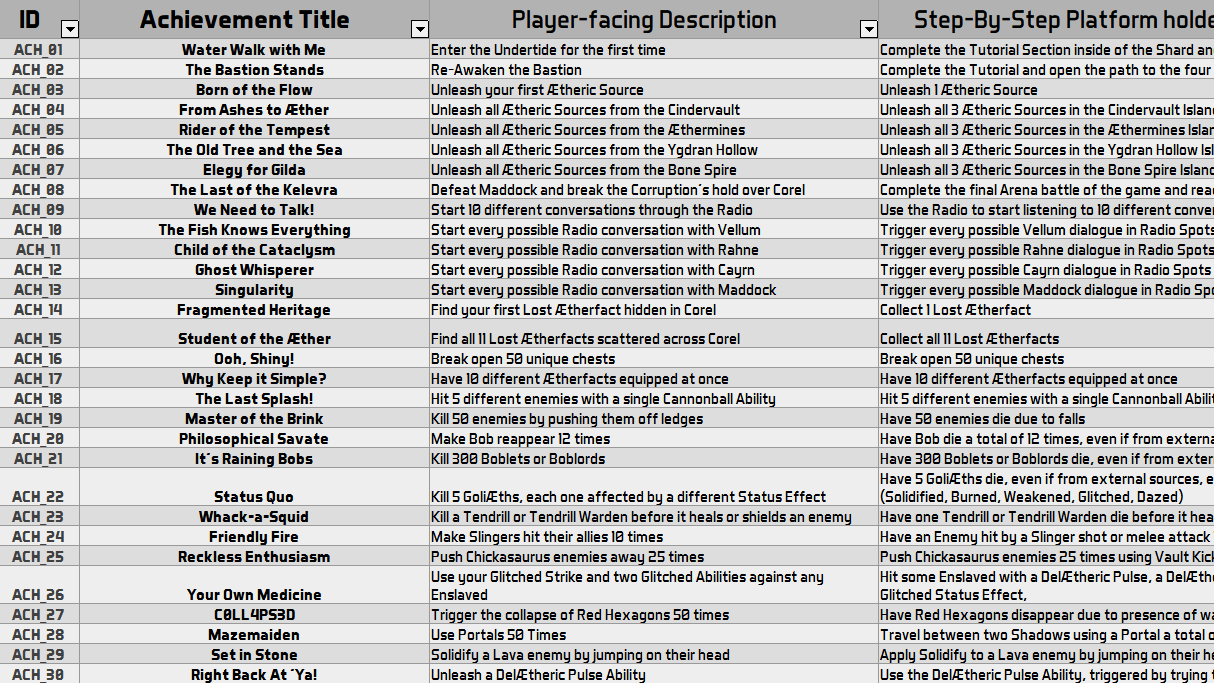
This is the document we used to work on those Achievements, or at least a very ugly copy of that original document.
One idea that I wanted to keep is to have one Achievement per enemy archetype, trying to play onto their strength or relevance to put all six of them in the spotlight at some point.
A particular point of attention was to keep a steady Achievement repartition over time, so that there is a more-or-less constant stream of Achievement throughout a regular playthrough, as much as it is possible to account with playstyle variance.
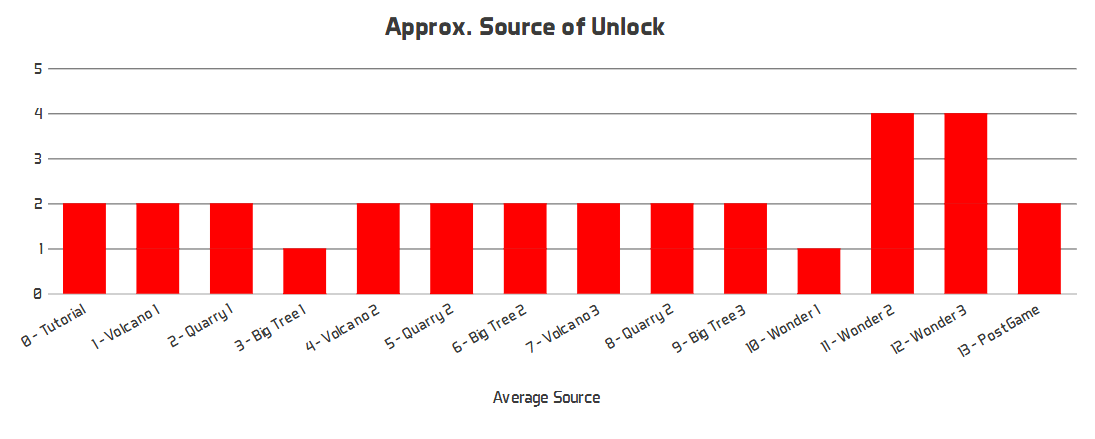
Over-time repartition of Achievements, we aimed for a flat distribution but you often end up with a bump at the start and end of a game, for obvious reasons.
As an exclusive treat for this article, here are some ideas that got simplified over time:
NONE OF THE NAMES ARE OFFICIAL! They are just my random placeholders.
- Stay Hydrated: Leech 500 litres of water from the ground.
- Analysis Paralysis: Have 10 unassigned Perk Points at once.
- Fuel… Fire…: Apply Dazed to 3 enemies while they are at least 10 meters away
- Slide Into The Void: Fall off the map while holding a Power Core
- 7.8/10 Too Much Water: Complete a source in Water Form from start to finish
Fading Echoes
I have already rambled enough about this game, so I’ll stop here!
Thank you very much for reading this very long article, I hope you liked it!
Special thanks to the team at Emeteria and New Tales for welcoming me into their environment and allowing me to work on Fading Echo with such a talented team, especially as a first experience!!
I’ve had a wonderful time on this game, and I hope you will like playing it as much as I liked working on it!
Take care, and see you later!
Also available on Epic Games Store, PlayStation 5 and Xbox Series X|S